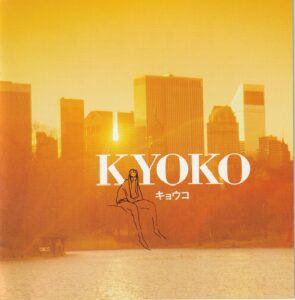
“KYOKO” Original Soundtrack
(1995-1996)
1- ESPERANZA | Javier Olmo & Orquesta Aragón
composer: Ramón Cabrera/ director : Rafael Lay Jr.
2- LA CACHIMBA, CAMARÁ | NG La Banda
composer & director : José Luis Cortés
3- PORTAL (KYOKO version)| NG La Banda
composer & director : José Luis Cortés
4- LA COMPARSA | NG La Banda
composer: Ernest Lecuona / director José Luis Cortés
5- CAMARERA DEL AMOR | Tony Calá & NG La Banda
composer: José D.Guiñones/ director : José Luis Cortés
6- LAS CUATRO PALOMAS | Zenaida Armenteros & Septet Nacional
composer: Ignacio Piñeiro / director : Francisco Amat
7- Lagrimas Negras LAGRIMAS NEGRAS | Zenaida Armenteros & Septet Nacional
composer : Miguel Matamoros / director FFrancisco Amat
8- NOSOTROS | Javier Olmo & Orquesta Aragón
composer : Pedro Juncos Jr. / director : Rafael Lay Jr.
9- BONITO Y SABROSO | Tony Calá & NG La Banda
composer: Benny Moré / director : José Luis Cortés
10- ME VOY PAL PUEBLO | Tony Calá & NG La Banda
composer: G.Mercedés Valdès/director , José Luis Cortés
11- SIBONEY | Javier Olmo & Orquesta Aragón
sax alto : Herman Belasco
composer: Ernest Lecuona / director José Luis Cortés
12- LA BRUJA (KYOKO version) | NG La Banda
composer & director : José Luis Cortés
The music for the film KYOKO — its concept kept changing as the screenplay progressed and shifted. Cuba has countless beautiful songs, an uncountable number of bands old and new mixed together, and so many kinds of music that you can’t grasp them right away.
From all of that, I first had to choose the one song that should become “Kyoko’s theme.” Of all Cuban songs, the most famous is “Siboney,” by Ernesto Lecuona. To express a certain mood the film carries, the theme song had to be familiar enough to hum on the way out of the cinema, and at the same time aching, and beautiful, and it had to have that Cuban kind of exhilaration too.
Using the unit of NG La Banda, in February 1995, between Saki Takaoka’s dance lessons, we began recording “Siboney.” The image I had for the singer was Alberto Lavariati, the wonderful vocalist of the Lecuona Cuban Boys, the super-popular band of the 1930s–40s.
The singer originally planned was an old men’s duo, Lorito and Armandito, from the group Roberto Faz. Faz was one of Cuba’s representative bolero singers, and Lorito had sung in a duo with Faz himself, far back in time, in the band Conjunto Casino. Even after Faz himself died, the band Conjunto Roberto Faz remained, and Armandito had joined because he had a voice very like Faz’s.
I love the beautiful voices of those two old men, and I had used them on Murakami’s Cuban Canzone as well. But the two voices were not suited to “Siboney.” Ernesto Lecuona was originally a classical composer, and “Siboney” had a particularly strict melodic line.
We called many singers to the studio late at night and had them sing, but none could sing it like Lavariati.
In despair, I pulled myself together — “but this is Cuba, surely someone must exist” — and searched desperately, getting to see every kind of video at TV stations.
That is how, as the thirteenth, Javier Olmo came to the studio.
Javier was the son of José “Pepe” Olmo, who had been side vocalist with Orquesta Aragón, and he was a member of the National Choir.
We waited at the exit of the venue for the choir’s performance to end, and got him into the car and brought him straight to the studio. The telephone wouldn’t go through, and we had the studio’s reserved time, so there was no other way.
Javier, with almost no rehearsal, sang in just five minutes, perfectly, the “Siboney” that the other singers had struggled with for two or three hours and ultimately could not sing.
Delighted and excited, I said, “Your voice is going to ride on the film and play all over the world” — but Javier just blinked, with a look of “What are you talking about?” That was my meeting with Javier.
Javier’s voice was so wonderful that we decided to re-record the inserted songs “Esperanza” and “Nosotros,” which were supposed to use the originals, in his voice. To commission the two pieces of accompaniment, I went to see Orquesta Aragón, who were performing in a country town two hours from Havana. Aragón is the legendary orquesta about to mark its fiftieth anniversary. The two geniuses Richard Egües and Rafael Lay created Aragón, and its repertoire — limited to what they’ve recorded — is said to exceed 800 songs.
Currently, Rafael Lay’s son is the leader, with their performing activity centered on Central and South America. That Aragón was, unusually, in Cuba. In a country-town restaurant, pitch dark in the middle of a power outage, I asked Rafael Lay Jr.: “Record for the film for me.”
“Oh, you’re Murakami — you’re young,” Junior said, and casually took the job.
And so “Esperanza” was born. It was a recording done in the blink of an eye. When it was over and we paid everyone their fee in cash, one could hear voices shouting, “All right, now to buy liquor and head to the women’s place.”
The newly recorded “Esperanza” came out so well that we decided to record the other inserted songs anew as well. Septeto Nacional, with Pancho Amat as director, and the singing by Zenaida Armenteros. Septeto Nacional is the legendary band created by the great Ignacio Piñeiro. Pancho is the genius tres guitarist formerly with Adalberto Álvarez’s band, and Zenaida was the in-house singer of Conjunto Folklórico Nacional, where Saki Takaoka had taken her dance lessons. With that combination, we recorded “Las Cuatro Palomas” and “Lágrimas Negras.”
In the end, the film came to use songs that represent Cuba, both old and new.
Aragón, Ignacio Piñeiro, Benny Moré, Trío Matamoros, Lecuona, and NG La Banda and José Luis Cortés.
This music supported, and saved, the film KYOKO.
In particular, “Esperanza” will probably become, I think, one of the most important songs of my life.
5 Dec. 1995 Ryu Murakami
Produced By : Ryu Murakami
Directed By : José Luis Cortés (M2,3,4,5.9,10,11,12), Rafael Lay Jr. (M1,8), Franclsco Amat (M6,7)
Recorded & Mixed By : Rolando Santos(M1,4,6,7,8,11), Sinpachirou Kawade(Music lnn)(M2,3)
Recorded By : Rolando Santos, Ramón Alom Suarez(M5,9,10)
Mixed By : Shinji Nishikubo(M5,9), Shinpachirou Kawade(M10)
Mastering Engineer: Thoshiya Horiuchi