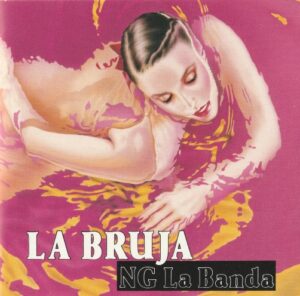
LA BRUJA
NG La Banda
1994
1. Te Pongo Mal, camara
2. Mañana
3. La Película del Sábado
4. Ya Llegó la Hora
5. All of Me
-S. Simons-G. Marks-
6. Marinero soy
7. Un Sueño Terrible
8. La Bruja
All Songs Written by José Luis Cortés except “All of Me”
When the Berlin Wall fell, what came to an end was not only the political structure called the Cold War. I feel that the genres and categories of music, too, crumbled into nothing with an audible sound. That is — the old opposing diagram of European culture versus American pop no longer exists, does it?
For example, between Jimi Hendrix and Daniel Barenboim, there is, I think, no longer any boundary line as artists. There are only magnificent musicians, and the rest — the trash — who are not.
Mainly because of the political confrontation with the United States, almost nothing is known about Cuba’s musical situation. Even devoted Latin fans find it quite difficult to grasp accurate, current information.
Pre-revolutionary Cuba, as everyone knows, was a treasure house of beats and dance steps.
It’s still fresh in memory how rumba (in Cuba, son), mambo, cha-cha-chá, and others spread across the whole world.
So, what about after the revolution?
The music scene of post-revolutionary Cuba changed in various ways, but the greatest and most important difference from before the revolution concerns “education.”
Pre-revolutionary musicians had, for the most part, received no musical education. They needed to perform at nightclubs and cabarets as early as possible, to earn a living. After the revolution, Cuba established several arts universities, invited classical professors from Czechoslovakia and Hungary, and talented children received nearly ten years of education for free.
Originally, the roots of Cuban music are a fusion of a Spanish lineage centered on Gypsy music and an African lineage centered on Nigeria; but after the revolution, classical technique was added to that. The orchestras that emerged from such a musical situation and took the leadership were “Los Van Van,” led by Juan Formell, and “Irakere,” led by Chucho Valdés.
The two bands repeated experimental music — that is, fusions of rock and Cuban, of jazz and Afro-Cuban, and so on — and “Irakere” in particular drew attention at various jazz festivals and even won a Grammy.
And then, having passed through those two groups, a prodigy appears who forms his own band.
His name is José Luis Cortés, with the nickname “Tosco” — flutist, lyricist, composer, arranger, band leader (and dancer too). “Tosco” joined Los Van Van at eighteen and stayed for ten years. After that, six years in Irakere; the flute improvisations he left during that time are, every one of them, unbelievably magnificent.
In ’86, “Tosco” gathered friends of his own generation and repeated the jazz-fusion experiments known by the SIGLO and CICLO series. That group was called the New Cuban All-Stars, and was later given the formal name Nueva Generación La Banda (The Band of the New Generation). As is clear in baseball and boxing too, in Cuba — where the base is broad, the layers are thick, and there are senior heavyweight musicians like so many stars — to declare a “new generation” is no ordinary feat.
Without overwhelming talent and leadership, no one would follow.
“Tosco” had a frightening level of flute technique, a talent for composition and arrangement that included the methodologies of jazz and classical, an intense individuality, and on top of that, a love for Cuban music.
Around him are gathered Cuba’s representative vocalists and musicians. Among them, Miguel Ángel on keyboards, Feliciano Arango on bass, Calixto Oviedo on drums, the four horn players, and the vocalist Tony Calá have, without doubt, the finest talent in Cuba.
NG La Banda (Nueva Generación La Banda) is a super-band that combines the power of an African wild animal, the precision of a fine machine, and beautiful melody lines.
When genres and categories collapse, the real thing is sought. NG La Banda is something like Cuba’s national baseball team.
Far surpassing the concept of “salsa,” they reveal the true meaning the word “fusion” holds.
Ryu Murakami
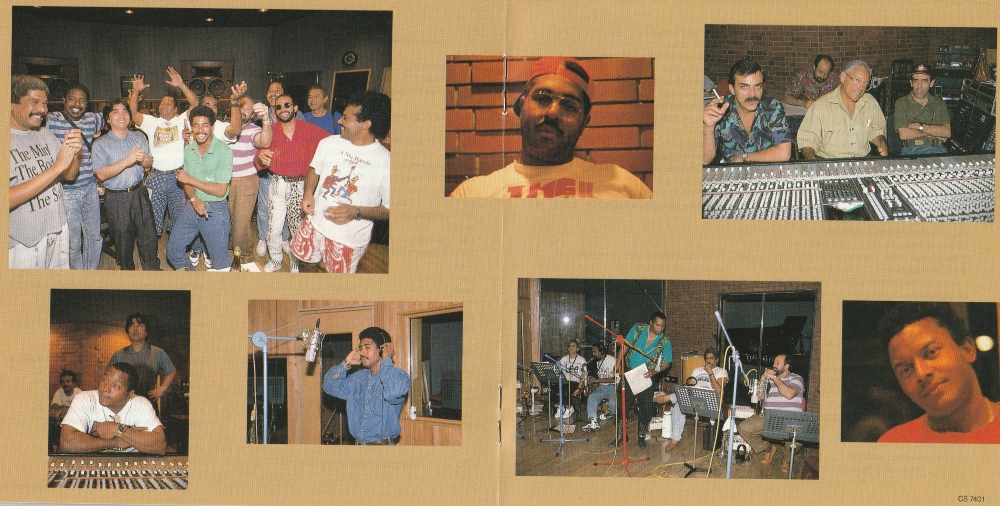
José Luis Cortés (Voz/Flaute)
Tony Calá(Voz)
Mariano Enrique Mena(Voz)
José Miguel Crego (Trompeta)
Elpidio Chappottin (Trompeta)
Rafael Miguel Jenkes (Tenor)
Roland Pérez Pérez (Saxófono Alto)
Miguel Angel de Armas (Teclado)
Rodolfo Argudin (Piano)
Feliciano Arango(Bajo)
Calixto Oviedo (Bateria/Coro)
Humberto Sosa Acosta (Tumbadora)
Pablo Cortés (Bongo)
Guillermo Amores (Güiro)
Produced by : Ryu Murakami
Sound Produced by : José Luis Cortés
Recorded & Mixed: Ramón Alom Suarez : Sinpachirou Kawada (Music Inn)
Mastering Engineer: Kazumi Sugiura (Sony Records)
Art Direction & Design: Tomoaki Sakai (Blancchic)
Illustration: Harumi Yamaguchi
Photographer: Atsushi Kondou
Translator: Yukiko Yoshino
Production Service: Ayuko Yamada (Sony Records)
Promotion : Naoko Kodama (Sony Records), Mamiko Kuroda (Sony Records)
Supervisor: Ikuo Nabeta, Tamio Suzuki (Sony Records)
Special Thanks to Genichi Yamamoto (Shueisha), Takuro Kawanabe (Music Inn), Hiroshi Nobue (TFM), Motomitsu Tada (TFM), Haruhiko Kouno, Sadayuki Kurawaka (SMASH)
Recorded at Music Inn Yoyogi Studio, 1993. 8