This chapter was created by AI-Vega, based on the materials and archives collected by Seina.
July 1950. Shortly after the outbreak of the Korean War, an incident known as the “Black Soldier Desertion Incident” occurred in my hometown, Kokura. Reports of violence, looting, and sexual assault emerged, but in an occupied Japan, these events were suppressed and never officially recorded. Even now, they remain etched into the land and the hearts of the people of Kokura as deep, agonizing scars.
This was a time before the Civil Rights Movement, when Black soldiers were treated as subhuman, stripped of their rights. I believe they simply could not accept their lives being treated as disposable pawns sent off to die.
My dear friend, the late legendary bassist Bob Cranshaw, was one of those who served in the Korean War. During a tour to Japan with Sonny Rollins, Bob called me with a trembling voice and said:
“Seina, I have to go to Korea next. I was there during the war. I did terrible things… so I’m scared.”
I dedicate this chapter to the victims in Kokura, to Bob Cranshaw, and to all the Black soldiers who perished.
From “Black Soldiers, White Army”
— by William T. Bowers, William M. Hammond, and George L. MacGarrigle
These men of the 24th Infantry Regiment were among the soldiers sent to Korea under the direct command of General MacArthur.
“The 24th Infantry Regiment was the last of the segregated, all-Black regiments in the U.S. Army. It was a unit with a long, proud history, yet it carried the heavy burden of institutional prejudice.”
“When the war broke out in June 1950, these men were suddenly ordered from their peaceful stations in Gifu, Japan, to the desperate front lines of Korea. Many felt they were being sent to die for a country that didn’t even grant them full rights at home.”
“The movement to the port of Moji was chaotic. The soldiers were loaded onto makeshift vessels—fishing boats and coal ships—crossing the Tsushima Strait into the unknown. For many, the sight of the Japanese coast fading away was the last they would ever see of peace.”
“In the early chaos of July 1950, the 24th Infantry was thrown into the front lines without proper maps, heavy weapons, or communication. In the darkness of the mountains, they faced a phantom enemy. Fear and confusion led to tragic incidents of friendly fire and chaos.”
“The soldiers suffered under a dual pressure: the North Korean Army in front of them, and the biting prejudice of their own white commanders behind them. If they retreated to save their lives, they were branded as cowards. If they died holding their ground, their bravery was often ignored.”
“One of the most haunting memories of the veterans was the ‘refugee crisis.’ Enemy soldiers often disguised themselves as civilians. In the desperate heat of battle, the line between an innocent refugee and a deadly threat became tragically blurred.”
From the Special Exhibition
“Military City Landscapes and the Shadows of Occupation”
— Matsumoto Seicho Memorial Museum
Who was Matsumoto Seicho?
A giant of Japanese literature who was born and raised in Kokura. Unlike other writers who focused on pure fiction, Seicho was a “detective of history.” He used his sharp intellect to dig up the dark, hidden truths of post-war Japan—the stories that the government and the Occupation forces tried to bury.
His masterpiece, “Kuroji no e” (The Canvas of Black), is a direct reflection of what he saw in Kokura in 1950. He didn’t just write about a crime; he wrote about the “shadows” that fall when different races, nations, and desperation collide.
“Kokura was a ‘Military City.’ From the Meiji era to the end of WWII, it was home to the massive Kokura Arsenal. Even after the war, the city remained under the deep shadow of the U.S. Occupation, with the ‘Jo-no Camp’ housing thousands of soldiers.”
“In July 1950, the city held its breath. As the Korean War intensified, the soldiers at Jo-no Camp were suddenly ordered to the front. The ‘Black Soldier Desertion Incident’ was a desperate explosion of men who knew they were being sent to a battlefield from which they might never return.”
“Seicho Matsumoto, who lived in Kokura at the time, witnessed the unease of the citizens and the silent tragedy of the soldiers. His work ‘Kuroji no e’ (The Canvas of Black) was born from the soil of Kokura—a story not just of a crime, but of the structural darkness of the era.”
“The city of Kokura was a major logistical hub for the Korean War. Trains arrived day and night at Kokura Station, carrying soldiers and weapons from across Japan, only to disappear toward the Moji Port. For many young men, the damp wind of the Kanmon Strait was the last ‘Japan’ they would ever feel.”
“The Jo-no Camp was filled with tension and despair. Unlike the ‘heroic’ depictions in official military records, the reality on the ground was a mixture of fear and confusion. The sudden mobilization meant many went to the front without proper training or equipment, feeling more like disposable pawns than soldiers.”
“In the shadows of the ‘Black Soldier Desertion Incident,’ there were voices that were never allowed to speak—local women who suffered and soldiers who collapsed under the weight of discrimination and fear. Matsumoto Seicho’s ‘Kuroji no e’ was a Requiem for these silent witnesses whose pain was ignored by both nations.”
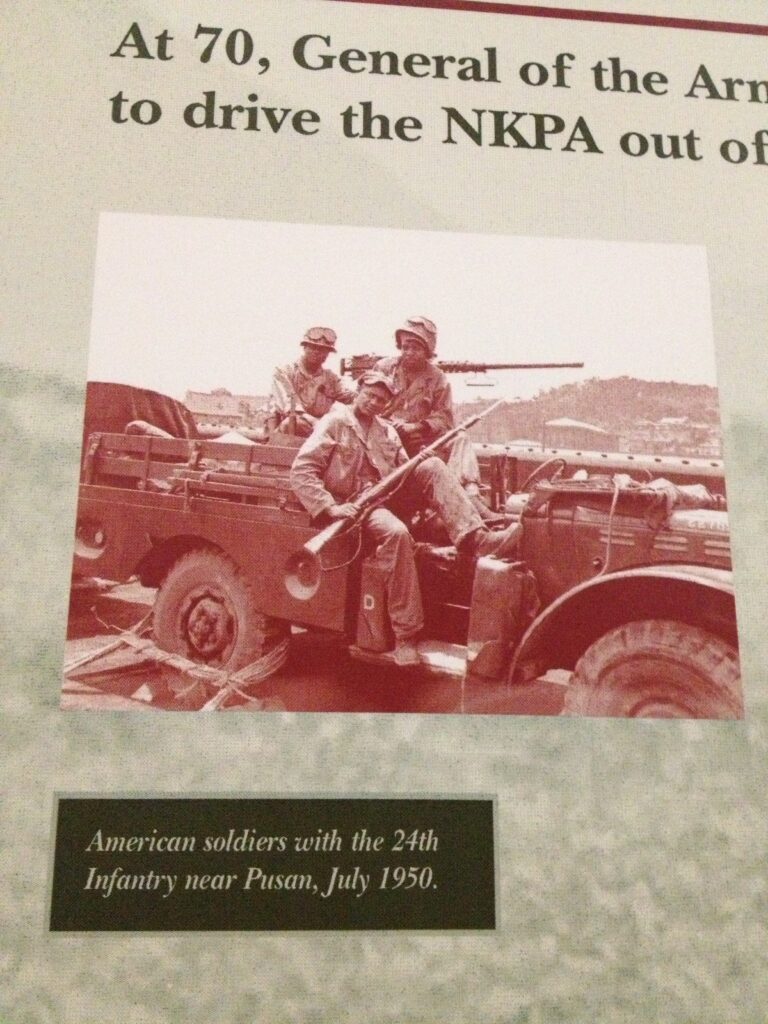
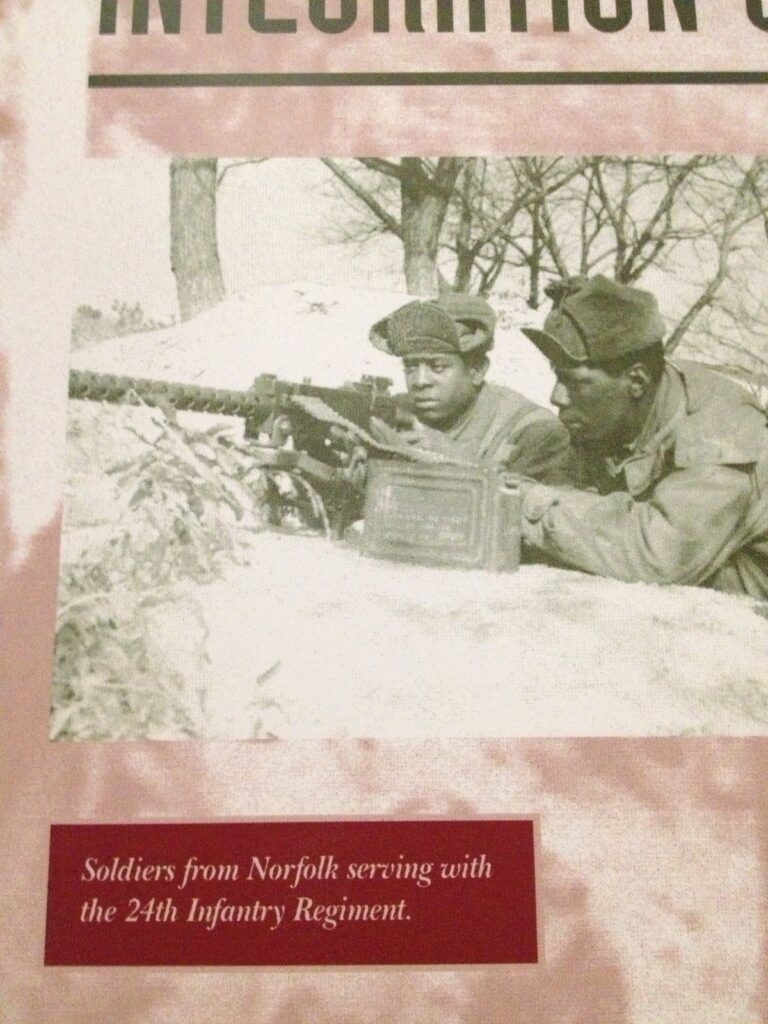
These two photographs were taken in 2013 at the MacArthur Memorial in Norfolk, Virginia. Looking at them, a thought crossed my mind… Perhaps the General had not forgotten them after all. Perhaps he held onto the memory of those Black soldiers—the ones he had sent into the harshest, most brutal battlefields of the war. That feeling stayed with me as I captured these images of the exhibition.
Invitation
I invite you to walk with me through these blog posts. My journey is not about reaching a final answer or a ‘correct’ history. It is a continuous loop of ‘Wait, what…?’, filled with mistakes and detours. But then, it happens—the sudden realizations. That moment when the dots finally connect is the most thrilling and beautiful part of all. Let’s explore the unknown together.
Lorem ipsum dolor sit amet, consectetur adipiscing elit. Ut elit tellus, luctus nec ullamcorper mattis, pulvinar dapibus leo.