Dear Ms. Shoko Shiraishi,
I received the CD. I like it.
I currently publish an email magazine called JMM, and in it I introduced you in the following way. I did not give your name, nor the URL of your website.
From the Editor
Thank you for your responses to Question 109. The question concerned the moral hazard that accompanies debt forgiveness; but as Mr. Yoneyama pointed out, there is a sense that the term “moral hazard” has taken on a life of its own. In the question I also wrote that “small and medium-sized enterprises have not received any benefit,” but your responses made clear that, even if not in the form of debt forgiveness, such enterprises have gained considerable benefit through the special guarantee framework of the Credit Guarantee Association and through the Civil Rehabilitation Act.
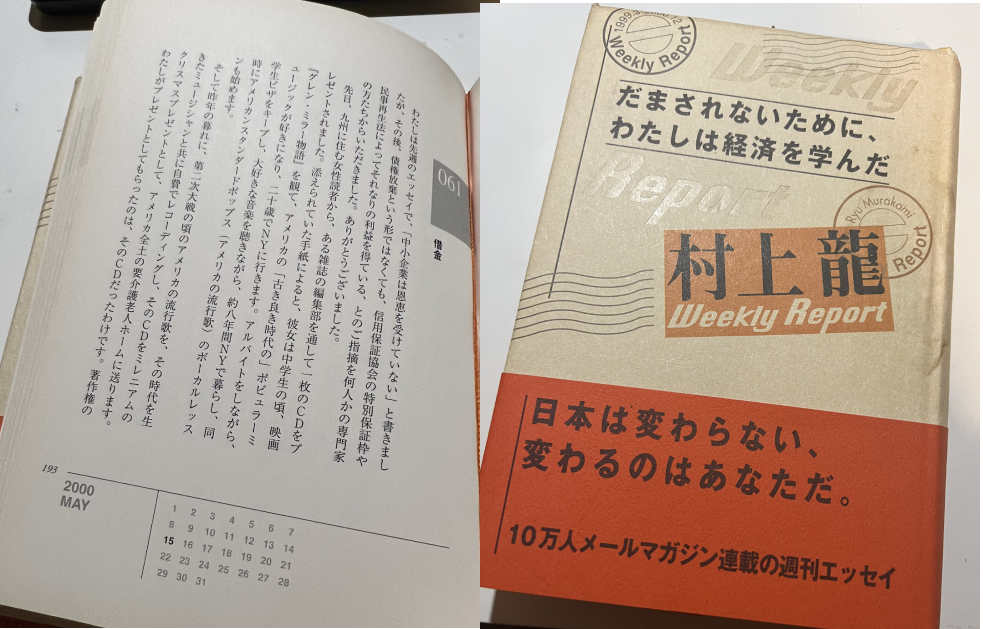
The other day, a woman reader living in Kyushu sent me a CD as a gift, by way of a certain magazine’s editorial department. According to the letter that came with it, she fell in love with America’s “good old days” popular music when she saw the film The Glenn Miller Story in junior high school, and at twenty she went to New York. Working part-time jobs, keeping a student visa, and listening to the music she loved, she lived in New York for about eight years, and during that time she also began taking voice lessons in American standard pops (American popular songs).
Then, at the end of last year, she recorded American popular songs from the era of the Second World War, at her own expense, together with musicians who had lived through that time, and she sent the CD as a millennium Christmas gift to nursing homes for the elderly across the United States. The CD I was given was that very recording. For reasons of copyright, I gather, it cannot be sold commercially. I did not think her act—sending it as a Christmas gift to nursing homes for the elderly all across America—was hypocrisy. She also holds a legitimate question about herself, a Japanese person, singing American popular songs. And there is no cloudiness in her motivation: her wish to convey that “your songs are still alive.”
As for the CD, it was something I could feel warmly toward. It begins with “I’ll Walk Alone,” continues through standards that are nostalgic for my generation, such as “Sentimental Journey” and “It’s Been a Long, Long Time,” and closes with “White Christmas.” The arrangements are orthodox, the playing is orthodox, and the singing too is utterly orthodox, overflowing with love and respect for American standard pops. And I thought her faintly husky voice was very lovely. That woman, I understand, is now working as a lounge hostess in a city in Kyushu, paying back the debt from her self-funded recording.
“What is called for is an explanation that can be understood by the common sense of ordinary people, who take it for granted that debts are to be repaid. And to explain one’s policy is, at the same time, a declaration that one takes responsibility for the results.” Mr. Kodama wrote this in his response to Question 109.
It need not be the word “moral hazard”—it could be decadence, or the breeding of distrust, or anything else—but I think the most harmful aspect of debt forgiveness being left unexplained, with responsibility left vague, is that something like resignation spreads throughout society. A certain linguist has pointed out that, while communication has several phases, what matters first is the sending and receiving of the message “I am attempting to communicate.” When a prisoner forbidden to speak knocks on the wall of the neighboring cell, it is because he is trying to show that an “attempt at communication” exists. It is the message: I have the will to communicate. One might call it a kind of meta-message.
I find it hard to believe that the meta-message of “an explanation that can be understood by the common sense of ordinary people, who take it for granted that debts are to be repaid” is being sent out by the banks and corporations involved in debt forgiveness. A society in which such meta-messages are insufficient grows decadent. As for how it grows decadent, a glance at the society pages of the newspapers over the past month or so should be enough.
May 2000
JMM (Japan Mail Media)