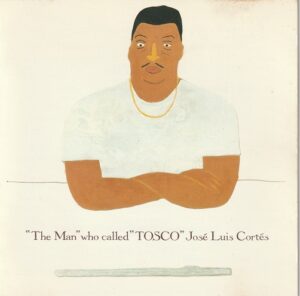
“The Man” who called “TOSCO”
José Luis Cortés
(1994)
1. Felicidade
-T. Jobim -V.de Moraes-A. Salvet-
2. La Sombra de tu Sonrisa
-P. F. Webster-J. Mandel –
3. Insensatez
-A.C. Jobin-
4. Meditación
-A.C. Jobin-
5. Canción de Orfeo
-L. Bonfa-
6. Wave
– A.C. Jobin-
7. Versión de Peruchin’s Samba
-José Luis Cortés-
8. Murakami’s Wife
-José Luis Cortés-
9. Fabera
-A.C. Jobin-
“The Man” who called “TOSCO”
To Cuba
In the capital, Havana, there are literally countless concert venues. From theaters that can stage opera and classical ballet, like the García Lorca Theater or the Karl Marx Theater, to discos, cabarets, nightclubs, open-air theaters, restaurant theaters, bars, lamp-lit patios, and even the streets — live music is performed in all sorts of places on weekends.
I have visited Cuba eight times in the past. Of course, since I move about as a tourist, my range is limited. These days, when Cuba is mentioned, only the news of its extremely worsened economic state catches the eye. It’s true that the shortage of goods, centered on gasoline, is beyond what we can imagine; but the kind of crude political face seen in Russia is not, on the surface, visible here. And among the Central and South American countries I have traveled — that is, Argentina, Brazil, Paraguay, Bolivia, Mexico, and so on — I got the impression of nations rotted through and through.
To an Italian trader who said, “What a poor country — I didn’t come to Havana to look at poor people,” my friend, a cameraman living in Argentina, said: “Have you ever been to Bolivia, or Peru, or Colombia? The other Central and South American countries are a million times poorer than this Cuba.” If you saw the slums of Bolivia or Paraguay even for a single day, you’d understand that “a million times” is no exaggeration.
Cuba is an easy-to-understand, healthy country — but I don’t intend to make a sociological analysis here. What I want to introduce is one artist. His name is José Luis Cortés, leader of a contemporary orchestra called NG La Banda.
An Encounter in the Heat
The first time I met José Luis Cortés was in March 1992, on my fourth visit to Cuba. It was the night I first went to see NG La Banda play live, at the open-air disco “Tropical” (its formal name is Salón Rosado Benny Moré).
“Tropical” is a concert venue like a giant pool with no water; in the daytime there are old-style shows mainly for older people, and on weekend nights the hottest popular bands appear for the young. Into a space that would hold at most 1,000 to 1,500 if you lined up chairs, they cram more than 5,000 people. It runs in two parts; the first starts around 9 p.m., and a popular band like NG appears around 1 in the morning. In a venue with nowhere to sit, the customers (admission is about a hundred yen in Japanese money) wait five or six hours, drinking Tropical’s house-made beer. This beer is made in the tank of a stall (though “stall” means it sells nothing but beer), and poured straight into whatever containers the customers have brought themselves. It’s supposed to be one cup per person, but most people bring empty plastic mineral-water bottles. Some even bring saucepans or milk-transport tanks.
Some say the beer is good, but it’s roughly made, so even I, who am quite confident with drink, get hit hard after one paper mug — dizzy, my mood turning beastly. Packed so tight that shoulders and elbows touch, the young ones drink that beer while waiting for the popular band, so naturally fights break out. The place is like the bottom of a pool, so no wind passes through and the heat fills up — another cause of fights.
When Caribbean blood and blades combine, tragedy sometimes occurs, so when a fight breaks out the police intervene at once. Their method of intervention is truly simple: they hit both parties with hard rubber batons to knock them out, and drag them off to a corner.
I was on the terrace for foreigners and VIPs, and in the three hours or so I waited, I saw about ten fights. At first I was startled by the way they suddenly struck people with hard rubber, but among them it wasn’t taken very seriously — there was no cruel feeling, no sense of misery; everything seemed to be sucked into the heat, into the damp, heavy air.
It was amid all this that I met José Luis Cortés. I had known NG La Banda’s music from CDs, so I was surprised — this is the leader of the band that plays so sensitively? José Luis was wearing a white suit, a black shiny shirt with a red necktie, and snakeskin boots. He didn’t look like a musician at all.
When the interpreter introduced me — “This is a writer who has come from Japan” — he nodded curtly, set a bottle of rum down on the table with a “thunk,” and said, very haughtily, “Well, help yourself.” What an arrogant guy, I thought. He was like the second-generation boss of some yakuza family. That was our first meeting.
Before the Tropical Shower
The day after the day after “Tropical,” I went out because they were said to be rehearsing. That day, Havana was struck by a tremendous shower; the roads turned into rivers, and here and there old Soviet-made Lada cars stood stranded with their hoods open.
I love tropical showers and squalls. They have none of the sentiment of a Japanese evening rain. Before the rain comes, the sky first darkens in an instant. The feeling of a soft, thick shutter descending without a sound — besides day and night, there exists a gray time zone, different even from dusk, called “before the tropical shower.” Before the rain falls, a sexy cold wind blows. A wind like the caress of a woman’s tongue with water held in her mouth; and then, one drop, two drops fall, and after that a state resembling the ending of a symphony continues.
Hearing “rehearsal,” I had assumed they’d be doing it somewhere like a studio, but no. The contemporary orchestra that represents Cuba had set up their instruments in the garden of the mother’s house of one member, a trumpeter named Greco. The atmosphere was the same as when, in junior high, I did a Kinks cover band in a friend’s garage.
Because of the shower, the members who had no cars were late arriving. The main vocalist, Tony Calá, was coming to the rehearsal venue by shared bus. The members weren’t all there, so they couldn’t play as a group, and José Luis began to play the flute. Looking back now, that was probably a service for me.
The rain had completely stopped, and breaks were starting to form in the thick, soft, shutter-like clouds. Through the breaks, bundles of light poured in, layer upon layer, and the clouds moved at an uncanny speed. A wind of a different kind from the one that blows just before the shower — gentle on the skin — wafted by, and the palms and mangroves and mango trees in the garden swayed slowly, ever so slowly, and I heard that astonishing flute sound.
I had never heard a flute like that. The length of the breath, the utterly clear tone without a trace of muddiness, the outrageous speed of the trills as the notes rose and fell — the sound seemed visible to the eye, as something that emitted a kind of radiance.
The Pleasure of Releasing the Senses
I first touched Cuban music when I used a Los Van Van song as the theme for the film “Topaz,” and I first visited the country in June of ’91. It wasn’t that I was steeped in Cuban music from the start. Cuban music isn’t something just anyone immediately understands. It demands a certain code of the listener, too. The code itself is simple.
It is: “release the senses, and receive only the music.” It was only after I started listening to Cuban music that I realized — we receive music together with the information attached to it. “Mozart” is a proper noun and thus information; so are Herbert von Karajan, Luciano Pavarotti, the Vienna Philharmonic — all information. Likewise, hardcore, Chicago funk, Miami house, London techno, Berlin noise — all information; and when you add information like “currently in the New York club scene,” or “selected by a London DJ,” or “the last thing Wagner left,” or “in a Jim Jarmusch film,” then what gets sucked into our receptors is not music, but information.
There is a moment I will never forget, even now.
It was on the veranda of the Hotel Riviera, on my third trip to Cuba. I brought a compact playback device out onto the veranda and, looking out over the sea through almost 180 degrees, listened at full volume to Cuban music old and new. The sea and sky of Havana are, because no heavy or chemical industry exists, probably the most beautiful in the world. So beautiful that one of the correct answers to environmental problems seems to lie in Cuba. It erases every kind of superfluous social information, the way a drug acts on the metabolic substances and transmitters of the nerves.
Only the music came into my receptors. It was an experience at once religious and physiological — and though I’ll never know for sure, I even imagined that the discovery of the G-spot and orgasm might be something like this.
I felt only the music — that is, only the variously combined sounds — adhering to my receptors. Like a certain cut in a Fellini film, like the acceleration of an F1 machine, like the color of the aurora at the poles, like a Botticelli painting, it required no explanation at all.
That is how, through Cuban music, I was able to awaken to “music.” A receptor that has once learned the way to orgasm comes, quite naturally, to render the simplest possible judgments, regardless of genre.
Music that continues endlessly;
I
Music That Goes On Without End
In 1992 and 1993, I produced NG La Banda’s concerts. I also set up a label company, wanting to help José Luis create new, more advanced Cuban music, mainly through new recordings. It was the first time I’d felt that way about another artist.
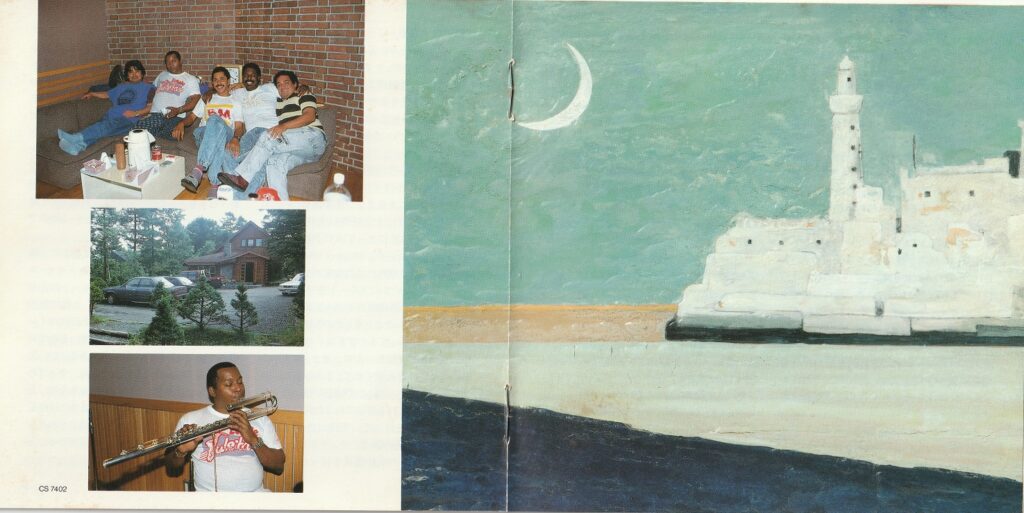
After the 1992 concert, I made a CD of José Luis Cortés’s flute solos. In a studio set in the woods by Lake Yamanaka, José Luis played the flute, on average, more than twelve hours a day. For me, to put it grandly, it was a religious experience. I felt as though I had touched, just a little, the secret of the power Cuba holds.
First, I gave José Luis a flute as a gift. It was Yamaha’s top-grade model. That, too — doing something patron-like — was a first for me. Even though it was top-grade, it wasn’t a handmade solid-silver instrument; yet José Luis was delighted like a child, and saying, “After something this good, surely something correspondingly bad is bound to happen, so we need to do a purification,” he actually performed a Santería ritual — an Afro-Caribbean religious rite — in a corner of the wind-instrument section at Shibuya Yamaha. I wanted José Luis to play a flute that could produce good sounds, and when I thought of this genius continuing to play on the instrument I had given him, I felt I could hold even the hope of surviving.
At Lake Yamanaka, José Luis played the piccolo, the bass flute, and the flute, not only in the studio but in the lodging cottage as well. Except for sleeping, eating, showering, and the toilet, he was playing the flute the whole time. According to one person’s testimony, when they shook him awake — “Get up, it’s already noon, if you don’t eat the dining hall will close” — he opened his eyes, searched for his flute, and began playing right there in bed.
When I woke, took a late breakfast, and walked through the woods to the studio, the sound of the flute always came from the cottage where José Luis was. There he goes again, I’d think, walking with a wry smile; but because he was doing it for that day’s improvisation, there’d be fresh phrases my ear wasn’t used to, and my feet would stop in spite of me. Yes, a good phrase after all, I’d think while listening — and suddenly, something appears. What vanishes is self-consciousness; the true nature of what appears, I don’t really know. Only that it’s something ominous, something that sets the chest astir.
In the woods where mist lingered, the flute’s sound rang out, blending with the rustling of wind and branches and the calls of birds, and yet standing far apart from them, and I felt my sense of time being lost along with my self-consciousness.
It was a strange experience, a little different even from, say, listening to the Quran on a hill in Tangier at dusk. While it was a mystical experience, I was listening to that flute with the clear understanding that its mysteriousness came from physical quality and mathematical arrangement. “Since when, exactly, have I been listening to this flute solo? How much time has passed since I began?” — such things became unclear, and the flute’s sound alone became something almost visible, something that seemed touchable by hand, flowing by at overwhelming speed, and my everyday sense of time disappeared.
The imaginative and constructive power in his improvisation — that is, José Luis’s playing ability — erases the everyday sense of time; and that is deeply connected to the essence of music in Cuba.
It is a kind of Santería. That characteristic also remains in Cuba’s own traditional dances, such as the rumba, and in that case the music is, in essence, performed as something that goes on without end.
Reconciliation with God
It was while we were recording the solo for “Manhã de Carnaval” (Black Orpheus). The recording of that part began after 1 a.m., and all of us were terribly tired. Even José Luis, with his gorilla-like upper body, his lion-like lower body, and the lung capacity of a water-polo player, was tired enough to let slip, “My lips really are starting to go numb.” The recording had already gone on for twelve hours, and saying it was medicine, we’d been drinking beer and rum and whiskey and cognac the whole time, so we wouldn’t get drunk, but we were reeling.
I worried — I, who was also about to collapse — that José Luis might collapse before long in such a state. He played the long, long solo of over eight minutes ten times, twenty times, without rest, and each time, he shouted at the mixer, “No good, erase it all.”
As the takes piled up — thirty, forty — I could feel the whole studio wrapped in an uncanny tension. José Luis grew more and more exhausted, and as proof, his breath gradually broke up and grew short. Better to do it tomorrow; you can’t make something good when you’re tired — so I’d have thought, and so I’d have told José Luis, if I hadn’t known Cuba.
But the place music holds in Cuba is at the very opposite of spending a holiday afternoon elegantly and fully.
A Black slave, worn ragged from cutting sugarcane, comes back to the shack that is his home; or a white immigrant, finished with harbor labor, returns in tatters to a slum in the city. (This is an old story; after the revolution there are no slums.) Their music begins from there. Rumba, son, conga (the music of the fiesta procession — not the name of an instrument) begins, they sing, they dance, and they are released, and gain a rightful exhaustion and the vitality to survive. What is needed in such a place is not the narrativity of movements as represented by the classics, nor the communal consciousness of “yes, we’re all comrades, aren’t we” as represented by folk songs and folklore and Japanese rock (ugh, it makes me sick, I could vomit) — but a strong, beautiful, aggressive and yet elegant “repetition.”
“I’m tired, so let’s do it again tomorrow” — that, I think, is the way of thinking of people whom the community has permitted to live forever on the land where they were born.
“I won’t stop playing the flute. I’ll play till I die. Right now, I’m wrestling with God.”
Saying things like that, José Luis kept playing. No good, erase it, once more, an eight-minute flute solo, no good, erase it, once more — repeating that, until even I grew hazy in consciousness, as if I were inside a strangely bright, beautifully colored nightmare. And then, as dawn broke, José Luis played an unbelievable solo, and it became the OK take. Everyone listening in the monitor room was stunned, and the one woman there burst into tears. Even Miguel Ángel, the pianist, who is Cuban, muttered “unbelievable” ten times.
“I made up with God, and so God took my side.”
José Luis, who came back to the monitor room saying that, bore no trace of fatigue at all, his face like one after a sauna. I felt — though truly this almost never happens to me — the existence of something great and beyond understanding, and the gooseflesh would not leave me.
“Nature” Is Nothing but a Relationship
I have written at length about Cuba’s music, and about the musician José Luis Cortés, in this magazine whose theme is “nature,” and there is a reason for that. Cuba, of course, has “nature” too. The Sierra Maestra in the east, where Guevara and Castro holed up, remains deep jungle even now, and the resort of Varadero has, as far as I know, the most beautiful sea in the world. But I don’t feel like going to Cuba to dive, nor do I feel like getting in a jeep and climbing the Sierra Maestra.
Nor do I intend to write that I like human beings more than “nature.” It’s simply that, in Cuba, what captured me most strongly was the music.
Up to now I have experienced many impressive instances of “nature”: the aurora in Lapland, the tiger-inhabited jungle of Malaysia, the deep sea of Micronesia where sunken ships pile up, the never-setting sun of northern Alaska in summer, the hot wind and sandstorms and sunsets of the Sahara, a solitary island in the Gulf of Burma where Negroid people live — but when I use the word “nature,” I find myself imagining the music of Cuba.
Why is that?
It’s because, for me, Cuban music is the symbol of the sacred. It is, fundamentally, the song of those who have lost their homeland; from the very start it fuses with the other, presupposes an outside, and intends a scientific assimilation with something cosmic. For me, a “nature” unrelated to such an intention makes no sense. For example, is there anything in this world more “natural” than a Mozart piano concerto?
I think “nature” is not a state but nothing more than a certain relationship.
When we grow tired of setting up an outside and searching for the other, don’t we end up seeking “nature” as a phantom of the self? The view of “nature,” including the ecology boom, looks like hope but is in fact extremely unscientific and feeble.
Most ecologists blindly identify the self with the environment and merely depend on it. That is, what is being spoken of is not “nature” but the self.
Mozart, and the musicians of Cuba, are not copying “nature.” Nor are they creating “nature.” Nor are they within “nature.”
They are only proving, through music, that “nature” is nothing but a relationship.
It’s obvious, but however much we on this earth may speak of “great nature,” in terms of the cosmic system it’s something like garbage.
So I don’t want to speak of “nature” as a projection of the self.
For example, I have no interest whatsoever in things like “let’s protect the earth’s environment.” Humankind isn’t so great, and the earth is, fundamentally, a single consumable material.
What matters to me is not searching for, and speaking of, “nature” as a refuge for self-projection within that consumable material.
It is only to show a certain relationship, by presenting the information I hold with its arrangement changed. Within the music of Cuba is everything of what I think of as “nature” — getting to know José Luis Cortés, I gained that conviction.
Ryu Murakami
Reprinted from Shinchosha’s “Sinra,” March 1994 issue
José Luis Cortés: Flute / Percussion / Chorus
Miguel Angel de Armas: Keyboard / Percussion / Chorus
Feliciano Arango: Bass / Percussion / Chorus
Calixto Oviedo : Drums / Percussion / Chorus
Staff
Produced by: Ryu Murakami
Sound Produced by : José Luis Cortés
Recorded & Mixed : Ramón Alom Suarez
Sinpachirou Kawada (Music Inn)
Mastering Engineer: Kazumi Sugiura (Sony Records)
Art Direction & Design: Tomoaki Sakai (Blancchic)
Illustration: Hisashi Nishikata
Photographer: Atushi Kondou
Translator: Yukiko Yoshino
Production Service: Ayuko Yamada (Sony Records)
Promotion: Naoko Kodama (Sony Records)
Mamiko Kuroda (Sony Records)
Supervisor: Ikuo Nabeta
Tamio Suzuki (Sony Records)
Special Thanks to Genichi Yamamoto (Shueisha)
Takuro Kawanabe (Music Inn)
Hiroshi Nobue (TFM)
Motomitsu Tada (TFM)
Haruhiko Kouno
Sadayuki Kurawaka (SMASH)
Rie Akagi
Miyazawa Flutes MFG Co., Ltd.
Recorded at Music Inn Yamanakako Studio, 1993. 8