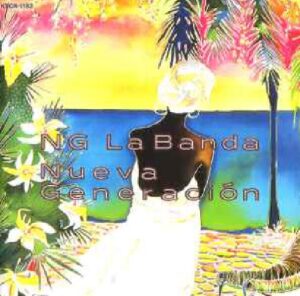
Nueva Generación
NG La Banda
1992
1. POR QUE TU SUFRES CON LO QUE YO GOZO
2. LOS SITIOS ENTEROS
3. TE REGALARÉ MI MEJOR CANCIÓN
4. RAP SE LA APLICARON TODAS
5. YO SOY UN HOMBRE, CAMARÁ
6. QUE VENGA LA FIERA, CAMARÁ
7. RAP DE LA MUERTA
8. NO SE PUEDE TAPAR EL SOL
Autor y Arreglista: José Luis Cortés
A Note for Enjoying NG, No. 1
There are various categories of Cuban music.
The most representative ones are SON and RUMBA.
The word RUMBA is very famous in itself. However, the Cuban rumba is fundamentally different from, for example, the Cuban rumba in ballroom dance programs.
Rumba is based on the 3:2 rhythm created by the clave, and sings and dances to an abstract and extremely complex syncopated beat that is impossible with a rhythm box.
There are also different types of Rumba, such as Guaguancó, Yambú, and Colombia.
The woman swings her hips by the hem of her skirt, and the man attacks her crotch. It is a sex-themed dance in which the woman wins if she successfully evades the attack, and the man wins if the attack is successful (by hitting the woman’s crotch with his hands, feet, or hips).
The dancers are mainly Afro-Cuban, and the lyrics sung are not in Spanish but in Afro (the language of various tribes such as Nigeria, Congo, and Angou). Of course, it’s very sexy, but because of Afro-Cuban’s characteristic soft movements and syncopated steps, it doesn’t feel too sexy. It’s extremely sophisticated.
Guaguancó is a fast-paced, male-dominated rumba. Yambú is characterized by its slow tempo, female-led music, and inviting gestures. Rumba Colombia is a demonstrational solo dance performed by one man.
In the second song, “LOS SITIOS ENTEROS,” you can hear Guaguancó’s rhythm in the middle.
There are parts where the composition consists only of percussion.
That rhythm is the Rumba.
Son is said to have originated in Santiago de Cuba in the east, but its origins are unclear.
SON is basically based on the 3:2 clave and consists of guitar, tres guitar, bongos, pace, and trumpet.
Other common ones include “guaracha”, “mambo”, and “cha cha cha”, which has a faster tempo than son. “Bolero” is a slow ballad. The farmers’ song “Guajira”. “Conga” is considered to be the prototype of samba. There are songs such as ”danzon,” which may be the prototype of tango.
Furthermore, when it comes to ”Son Cha”, ”Bolero Cha”, which are combinations of these, and ”Obatala”, ”Arara”, and ”Bembe”, which are used in Afro-religious ceremonies, I no longer know what they are.
Furthermore, when it comes to contemporary bands with many formations (NG is one of them), they often create new rhythms by themselves (a typical example is “Songo”, created by Changuito, the genius percussionist of Los Van Van) and then become more and more confusing.
From RUMBA to SON, one of the characteristics of Cuban music is the “montuno.” There is even a category called “son montuno,” which in Japanese means “calling,” and in English, “call and response.”
The response part is as important as the vocals of a solo singer.
For example, if you memorize this response chorus at a concert, you can sing along and enjoy it 100 times more.
By the way, in the lyrics of this liner notes, I have enclosed the Montuno part in [ ].
If you listen to all the songs over and over again and memorize them until the concert, you’ll have a great time.
Solo singers sing between Montuno and Montuno, and in this case, improvisation is allowed at the concert.
In Cuba, we come up with lyrics on the spot or create new ones, and each song goes on and on, and the audience sings and dances along with us.
If you want to know more, come to NG La Banda’s concert.
Notes for enjoying NG La Banda. Part 2
Cuban music has many categories.
The representative ones are, I’d say, son and rumba.
The word “rumba” itself is very famous, but Cuban rumba is fundamentally different from, say, “Coffee Rumba” or “Miami Beach Rumba,” or the Cuban rumba that appears in the ballroom dance repertoire.
Rumba is sung and danced over a beat that, built on the 3-2 rhythm struck by the claves, is abstract and extremely complex, syncopated in ways absolutely impossible for any rhythm box.
Within rumba too there are kinds — guaguancó, yambú, columbia, and so on.
The woman lifts the hem of her skirt and swings her hips, while the man attacks toward her groin. If she dodges the attack skillfully, the woman wins; if the attack succeeds (with a quick mock-touch at her groin, using hand, foot, or hip), the man wins — a dance with sex as its theme, ordinary enough if you want to put it that way. But the dancers are mostly Black, the lyrics sung are not in Spanish but in African languages (the tongues of various peoples — Nigerian, Congolese, Angolan, and so on), and of course it is extremely sexy; yet because of the soft carriage particular to Black people and the steps that move within the syncopation, it doesn’t feel obscene. On the contrary, it is very refined.
Guaguancó is fast-tempo rumba led by the man; yambú is slow-tempo, led by the woman, characterized by inviting gestures.
Columbia is a demonstrative solo dance by a single man.
In the second track, “I’ll Take You to the Rumba,” you can hear the guaguancó rhythm in the middle section.
There is a part where the playing is only percussion — that rhythm is rumba.
Son is said to have been born in Santiago de Cuba in the east, though its origins are not clear.
Son, too, is basically built on 3-2 claves, with guitar, tres guitar (think of it as a 6-string version of a 12-string guitar — three courses of two strings each), bongos, bass, and trumpet.
The word son means “song”; perhaps its source is the trova of Spanish immigrants who long ago sang accompanied by a single guitar (a man is a trovador, a woman a trovadora — a wandering minstrel).
Other common ones include the guaracha, faster in tempo than son; mambo; cha-cha-chá; the slow ballad bolero; the farmers’ song guajira; conga, which is thought to be the original form of samba; and danzón, which may be the original form of tango. Then there are composites such as son-cha and bolero-cha; and once you get to Obatalá, Arará, Bembé used in African religious rituals, I have no idea what is what anymore.
And once you get to contemporary bands with large lineups (NG is one of them), they create new rhythms of their own — the representative example being songo, created by the genius percussionist Changuito of Los Van Van — and the confusion only deepens.
From rumba to son, one feature common to Cuban music is what’s called montuno. There’s even a category called son montuno. In Japanese it would be “kakeai” (back-and-forth); in English, “call and response.”
The response part — this is no less important than the lead singer’s vocal.
For instance, at a concert, if you’ve memorized the response chorus, you can sing along and enjoy it a hundred times more.
By the way, in the lyrics of these liner notes, I have placed the montuno parts in [ ].
If you listen to every song repeatedly and memorize them by the time of the concert, it’ll get tremendously exciting.
Between montunos, the lead singer sings, and in this case improvisation is permitted at the concert.
Coming up with lyrics on the spot, or making new ones, one song goes on and on, and the audience sings and dances along — that is Cuba.
If you want to know more details, come to an NG La Banda concert.
Note, No. 2
There is no Cuban music without “song.”
Cuban music without vocals — performance only — does not exist, from the music of African religious rituals through rumba, son, and up to the modern salsa bands.
There are jazz players too, represented by Gonzalo Rubalcaba, but I have not yet been moved by a Cuban jazz musician.
Why is there always “song”?
Because it was needed, surely; what is not needed cannot come into being.
Why it was needed — I will write the answer to that as the conclusion at the end of this note.
NG La Banda was formed in 1988 and has put out only three albums so far.
Tracks 4, 5, 6, and 7 of this CD were chosen from master tapes that were recorded but not released.
NG keeps writing new songs at a tremendous pace even now; the first reason not all of them become records or tapes is a shortage of raw materials such as polyvinyl chloride.
The frequent case is: José Luis Cortés composes; he or Hermán Velasco orchestrates; they rehearse repeatedly; they perform it tens, hundreds of times at concerts; and only then do they record.
By that point everyone has it completely memorized, and arrangements sometimes get improved. Under such circumstances, recordings can be made in a single take. So there’s no such thing as recording stretched over half a year; nor are master tapes preserved with the nervousness of Japan or America.
After all, a one-take recording is always possible.
The speed at which NG and other bands generate new songs exceeds our common sense.
Why are so many songs needed?
NG La Banda has three albums, but there are several session albums under the name Grupo Nueva Generación, centered on José Luis and Hermán.
“…Does Murakami like post-revolutionary Cuban music? Of course he does. After the revolution, this country built lots of music schools where anyone with talent could go for free; professors came from Eastern Europe; they drilled the classics into us, I practiced classics until I was sick of it — there were times I was really sick of it, and once I even protested, demanding we be allowed to play Cuban traditional music. Mozart and Haydn were Europe’s popular music of their time, but they aren’t our popular music. We wanted to do our own popular music. I’d been in Van Van and Irakere, but the desire to do my own music got stronger, and around 1986 I started doing sessions under the name Nueva Generación (New Generation). They’re all friends from music school. Nueva Generación was too long, so we decided to abbreviate it to NG. In the early days it was trial and error, but gradually, we got to be able to do our own thing.”
José Luis Cortés talking.
José Luis calls it trial and error, but I love the jazz-funk-like music of their early period. The sessions centered on José Luis and Hermán were filled with a sense of the birth of something new — taut with tension; sustained by the powerful taste of Cuban music and by their incomparably high playing technique, jazz’s overbearing quality has vanished.
The two LPs called CICLO are the finest. Listening to them, I thought, oh, jazz isn’t so bad after all, and I pulled old jazz records out of the shelf and listened. But the genuine jazz, I couldn’t listen to. The only ones I could enjoy, slightly, were Sonny Rollins and Eric Dolphy; the rest — Miles, Herbie Hancock, Charles Mingus — I couldn’t listen to. Just sticky and heavy, dumbfoundingly simple, monotonous, without tone color, and noisy.
Well, let me stop bad-mouthing jazz. Jazz has contributed to Cuba, after all.
Now then, I have to write the conclusion about “song.” Why do these lyrics in such chaotic states arise — to the point that the very division between “singing subject” and “listening object” becomes absurd?
It’s because in Cuba, singing a song, playing music, listening, dancing, the concert itself — none of these are “special things.”
There are people in this Japan, too, who say things like “music is part of life.” But if that were true — if everyone thought so — there would be no need to say so deliberately, and Japanese music would be stronger and be played overseas.
In Cuba there are hundreds of songs that an infant who has just begun walking, and an old person who can no longer walk, can sing together.
Song is not divided by generation.
Why is that?
Because it was needed. In order to survive, a large quantity of beautiful, strong songs was needed.
“Say, during the Cuban Missile Crisis, what were Cubans doing?” — I once asked a Cuban friend. She asked back, “The Cuban Missile Crisis?”
You know, when Khrushchev was carrying missiles in, Kennedy did a naval blockade, and we were on the verge of world war — when I said that, she answered with a look of weariness:
“Things like that happened dozens of times. I’ve forgotten.”
Ever since immigrants and slaves came to make up Cuba, up to the present, Cuba has been a string of crises and battles. The Cuban people, laughing off situations we cannot even imagine, get through hard times we cannot picture.
At such times, music was indispensable. They needed, through beautiful music, to forget themselves.
People polished their playing technique, devised dance steps, made beautiful songs anyone could sing, and kept sending respect and applause to outstanding musicians and singers.
The result, I think, was the birth of a country of music with no equal anywhere else.
Ryu Murakami
José Luis Cortés (Vocals /Flute, Director)
Antonio Calá (Vocals )
Mariano Enrique Mena (Vocals )
Issac Delgado (Vocals : 2,3)
José Miguel Crego (Trumpet)
Elpidio Chappottin (Trumpet)
Germán Velazco (Alto Saxophone, Music Director )
Rolando Pérez Pérez (Tenor Saxophone)
Miguel Angel de Armas (Keyboards)
Rodolfo Argudín (Piano)
Feliciano Arango (Bass)
Calixto Oviedo (Bateria)
Juan Nogueras (Conga)
Pablo Cortés (Bongo)
Guillermo Amores (Guiro)
Producción: Josê Luis Cortés
Grabación y Mezcla: Tony Lopez Alonso (1, 2, 3, 8)
Ramon Alom (4, 5, 6, 7)
Grabado: Estudio de grabaciones EGREM
Ciudad de la Habana, Cuba 1990/91
Pintura de la Carátula: Jennifer Markes (‘When Morning Breaks Dawn’)
Weiss McGraw Publishing
La pintura fue escogida por Ryu Murakami Dirección Gráfica: Hiroaki Nagai (N. G. Inc.)
Diseño: Makoto Yamamoto (N. G. Inc.) Coordinación Gráfica: Kazuko Sanbo
Agradecemos a Haruhiko Kono, Yvonne Moreira, Carmen Mayans, Caridad Diez, Galleria Prova y Dennis Weiss por la realización de este album joponés
Album japonés recopilado y producido por Ryu Murakami
Licenciado por ARTEX para Japón